
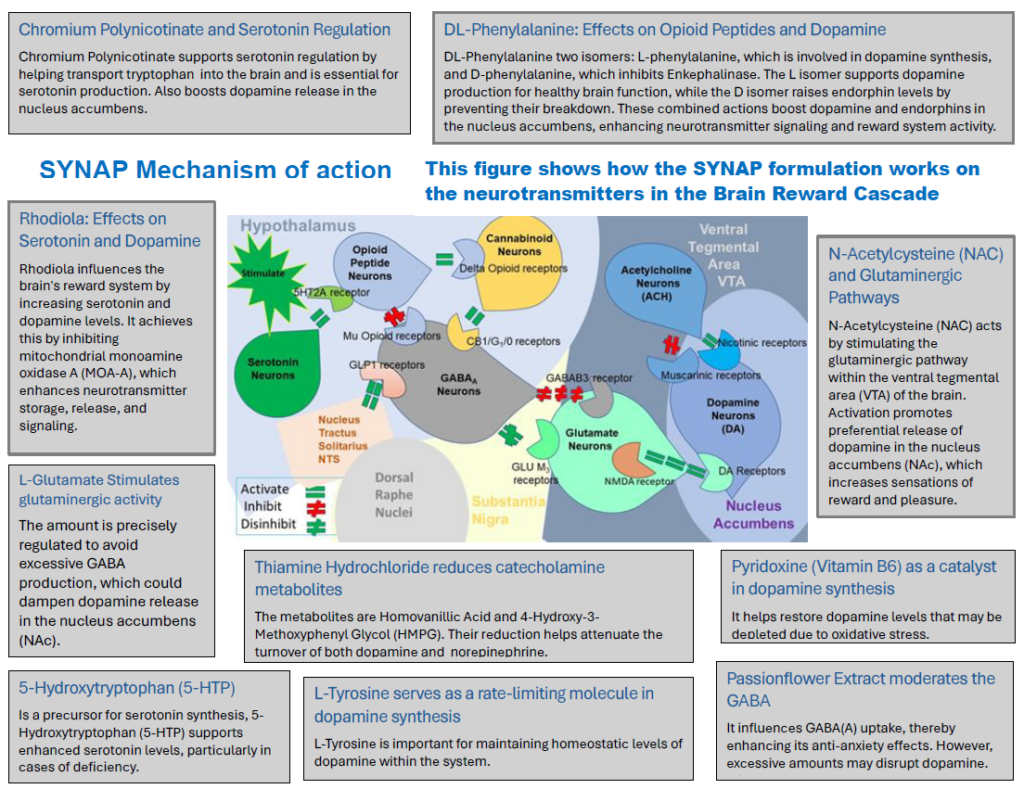
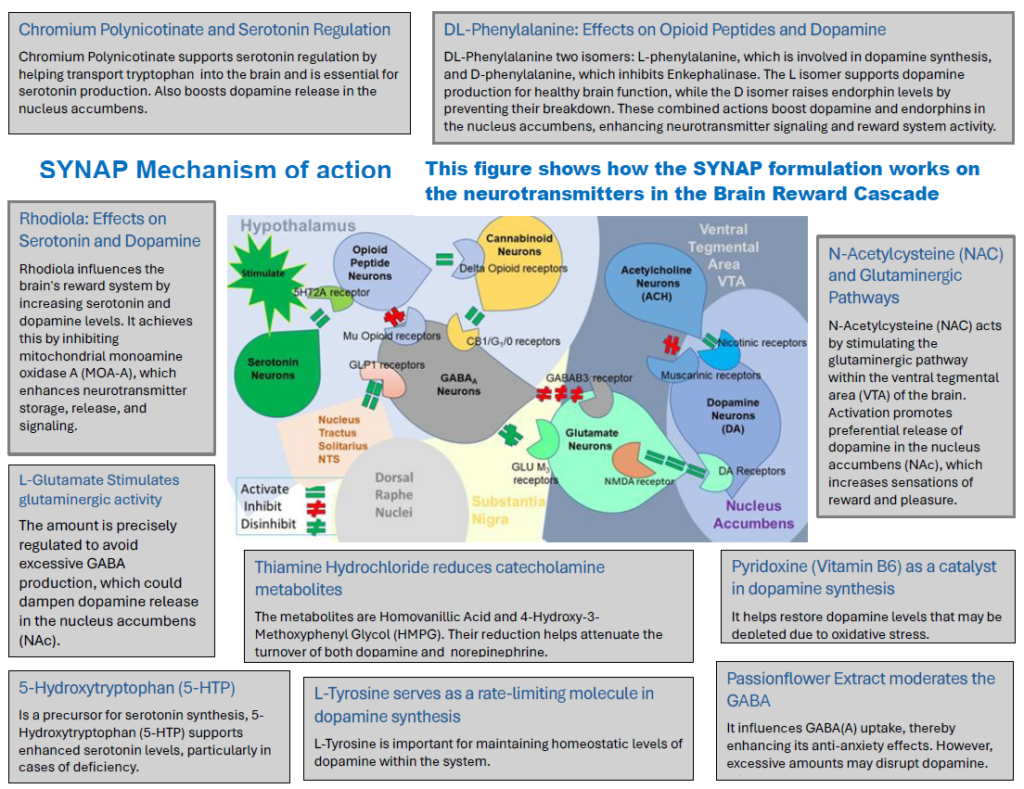
Research led by Kenneth Blum established a link between the Dopamine D2 Receptor Gene (DRD2) A1 allele which and severe alcoholism, binding studies of subjects with the A1 allele who also had alcoholism demonstrated decreased protein expression associated with a 30–40% reduction in dopamine D2 receptors. The product of the activation, inhibition, and disinhibition of neurotransmitters, such as serotonin, GABA, and endorphins, result in the balanced (homeostatic) release of dopamine at the pleasures center of the brain, (in the mesolimbic VTA). But, based on binding studies and other basic research Blim et al. identified a “hypodopaminergic†trait/state caused by either genetics, stress, or toxicity as “Reward Deficiency Syndrome†(RDS). Individuals with RDS have lower-than-normal dopamine release. Dopamine is responsible for pleasure and reward. With RDS, they may be more susceptible to engaging in activities that stimulate the release of dopamine (acute excess), such as drug use, gambling, or overeating, to experience pleasure and satisfaction. Many neuropsychiatric behaviors, when they become chronic add to the deficit of dopamine release that drives addictive, compulsive, and impulsive behaviors.
Development of neuronutrient therapy
Blum’s group developed a nutraceutical therapy (scientific code) KB220 to treat RDS and the Genetic Addiction Risk Severity (GARS) test to identify genetic risk for RDS.
Alcohol-preferring rodents with RDS injected directly with DRD2 receptors demonstrated a significant reduction in both alcohol-craving behaviors and self-administration of cocaine.
KB220 formulations to treat RDS.
Blum et al. propose a mild therapeutic, neuro-nutrient formulation that can accomplish D2 receptor increase to fight RDS, reducing craving, and stress.
Clinical tests
Clinical studies have shown that with the use of KB220Z, there is a significant reduction in AMA rates and reduced relapse, stress and increased focus.
Some neuroimaging research references
- Miller DK, Bowirrat A, Manka M, Miller M, Stokes S, Manka D, et al. Acute intravenous Synaptamine complex variant KB220â„¢ “normalizes” neurological dysregulation in patients during protracted abstinence from alcohol and opiates as observed using quantitative electroencephalographic and genetic analysis for reward polymorphisms: part 1, pilot study with 2 case reports. Postgrad Med. 2010;122(6):188-
The Blum et al. group used quantitative electroencephalogram (qEEG) analysis to show that KB220 formulations (induced homeostasis) significantly regulated the prefrontal cortices, particularly in the cingulate gyrus (a region for drug relapse) in abstinent psychostimulant users
- Blum K, Oscar-Berman M, Stuller E, Miller D, Giordano J, Morse S, et al. Neurogenetics and Nutrigenomics of Neuro-Nutrient Therapy for Reward Deficiency Syndrome (RDS): Clinical Ramifications as a Function of Molecular Neurobiological Mechanisms. J Addict Res Ther. 2012;3(5):139.
Quantitative electroencephalogram (qEEG) analysis also demonstrated that KB220 formulations (induced homeostasis) significantly regulated the prefrontal cortices, of people with Alcohol Use Disorder, and Opioid Use Disorder.
- Steinberg B, Blum K, McLaughlin T, Lubar J, Febo M, Braverman ER, et al. Low-Resolution Electromagnetic Tomography (LORETA) of changed Brain Function Provoked by Pro-Dopamine Regulator (KB220z) in one Adult ADHD case. Open J Clin Med Case Rep. 2016;2(11).
The neuro-nutrient formulation KB220Z provoked positive changes observed using LORETA in the neurological function of an adult with symptoms of ADHD.
- Blum K, Chen TJ, Morse S, Giordano J, Chen AL, Thompson J, et al. Overcoming qEEG abnormalities and reward gene deficits during protracted abstinence in male psychostimulant and polydrug abusers utilizing putative dopamine Dâ‚‚ agonist therapy: part 2. Postgrad Med. 2010;122(6):214-26.
One hour after oral administration, KB220Z overcame qEEG abnormalities during protracted abstinence in male psychostimulant, polydrug abusers.
- Blum K, Liu Y, Wang W, Wang Y, Zhang Y, Oscar-Berman M, et al. rsfMRI effects of KB220Zâ„¢ on neural pathways in reward circuitry of abstinent genotyped heroin addicts. Postgrad Med. 2015;127(2):232-41.
Dopamine activation observed on using rsfMRI, produced by the KB220 formulation increased functional connectivity and induced dopamine homeostasis across the brain reward circuitry one hour after oral administration in abstinent heroin users.
- Febo M, Blum K, Badgaiyan RD, Perez PD, Colon-Perez LM, Thanos PK, et al. Enhanced functional connectivity and volume between cognitive and reward centers of naive rodent brain produced by pro-dopaminergic agent KB220Z. PLoS One. 2017;12(4):e0174774.
State-of-the-art fMRI measurements demonstrated dopamine increases in the reward centers of naive rodent brains produced by pro-dopaminergic agent KB220Z
- Febo M, Blum K, Badgaiyan RD, Baron D, Thanos PK, Colon-Perez LM, et al. Dopamine homeostasis: brain functional connectivity in reward deficiency syndrome. Frontiers in bioscience (Landmark edition). 2017;22:669-91.
As well as dopamine increases fMRI measurements demonstrated enhanced functional connectivity and volume between cognitive and reward centers of naive rodent brains produced by pro-dopaminergic agent KB220Z
“Pro-dopamine regulator (KB220)†can optimize gene expression, restore the balance of the neurotransmitter systems in the brain, help prevent relapse by induction of dopamine homeostasis, by targeting DNA polymorphic reward genes to direct mRNA genetic expression.
Further Reading
Blum, K., Madigan, M.A., Fuehrlein, B., Thanos, P.K., Lewandrowski, K-U., Sharafshah, A., Elman, I., Baron, D., Bowirrat, A., Pinhasov, A., Braverman, E.R., Zeine, F., Jafari, N., Gold, M.S., 2025. Genes and Genetic Testing in Addiction Medicine. In: England, J.D.
(Ed.), Encyclopedia of the Neurological Sciences, vol. 6. Elsevier, Academic Press, pp. 303–318. https://dx.doi.org/10.1016/B978-0-323-95702-1.00227-X. ISBN: 9780323957021